The Midnight Hymn: Worship in Suffering with Paul and Silas
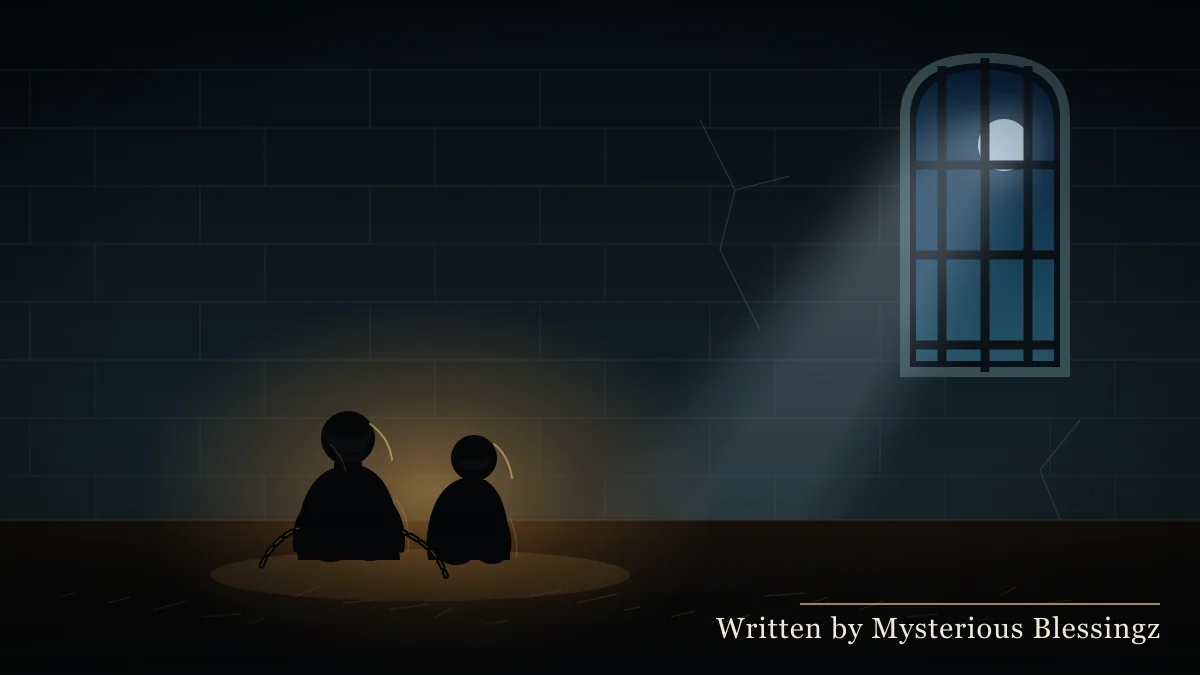
There are places where singing makes no sense. A hospital corridor at three in the morning. A house after the funeral. A cell where the door has been locked from the outside and the guards have gone to sleep. Yet worship in suffering is one of the most powerful realities in Scripture, and it is exactly where we meet Paul and Silas.
Their story in Acts 16 is one of the clearest pictures of hope in the dark that the Bible gives us.
They were not in Philippi by accident. They had come preaching Christ, and the preaching had cost them. A slave girl followed them for days, shouting that they were servants of the Most High God. Paul, worn down and grieved, cast the spirit out of her. Her owners saw their income disappear. They dragged Paul and Silas before the magistrates, accused them of unsettling the city, and had them stripped and beaten with rods.
Then they were thrown into prison. Not the outer cell, but the inner one. The jailer was ordered to keep them safely, so he put them in the deepest part of the prison and fastened their feet in stocks. Their backs were raw. Their hands were bound. The night was long, and nobody was coming.
And at midnight, they prayed and sang.
A Praise That Did Not Wait for the Earthquake
The text is almost annoyingly brief:
“And at midnight Paul and Silas prayed, and sang praises unto God: and the prisoners heard them.” — Acts 16:25, KJV
That is it. No explanation of what they sang. No mention of a sudden surge of emotional strength. No promise that they felt like singing. They simply prayed and sang.
It is easy to read the story backwards, knowing that an earthquake is coming. We imagine their song as the first domino in a chain that ends with open doors and a baptised jailer. But they did not know that. At midnight, the doors were still shut. The chains were still on. The earthquake had not happened.
Their worship was not a strategy for escape. It was a response to who God is before anything changed.
That distinction matters, because we are often tempted to treat praise as a lever. If I sing loudly enough, if I declare the right words, if I keep my voice steady, then God will have to move. That is not faith. It is a religious transaction dressed up as devotion. Paul and Silas were not negotiating. They were worshipping.
The Prisoners Were Listening
Luke adds a detail that is easy to miss: “the prisoners heard them.”
The other prisoners had no reason to expect a song. They were in the same darkness, the same stench, the same uncertainty. They had heard men curse and plead and weep. Now they heard two beaten men singing.
We do not know what those prisoners thought. Perhaps they assumed the men had lost their minds. Perhaps they leaned closer to the bars. But they heard something that did not fit the room.
Suffering is rarely private. People watch how we endure it. They listen to what we say when the door is locked and no one is clapping. Our response in the dark can become a witness we never planned to give.
This is not a call to perform. Pretending to be joyful when you are devastated is not worship; it is theatre. The psalms are full of complaint, confusion, and raw grief. But the psalms also refuse to let the darkness have the final word. They turn toward God even when the circumstances have not turned.
That is the kind of honesty that sings at midnight. Not a denial of pain, but a decision about where to direct it.
What the Earthquake Did and Did Not Do
At midnight, while they were singing, an earthquake shook the prison. The doors opened. Everyone’s chains came loose.
The jailer woke, saw the doors open, and drew his sword. In the Roman world, a guard who lost his prisoners could expect a shameful death. He would rather die by his own hand. But Paul shouted, “Do thyself no harm: for we are all here.”
The prisoners had not run. That is its own small miracle.
The jailer called for a light, fell down before Paul and Silas, and asked the question every human being eventually asks: “What must I do to be saved?” They told him to believe on the Lord Jesus Christ. He washed their wounds. He and his household were baptised. He set food before them, and the text says he rejoiced.
The earthquake was not only for the prisoners. It was for the jailer. God opened the doors not merely to get His servants out, but to bring a whole household in.
That is a pattern worth remembering. Sometimes God does not remove your difficulty because He is using it to reach someone you would never otherwise meet.
But we must be careful here. Not every prison story ends with an earthquake. Stephen was stoned. James was killed with the sword. Hebrews 11 tells us about faithful people who were tortured, imprisoned, stoned, sawn in two, and killed. They did not all receive deliverance in this life. Some received a better resurrection.
Worship does not guarantee rescue. It declares that God is worthy before the rescue comes.
Worship Is Not a Weapon
If we are not careful, the story of Paul and Silas can become a formula: sing at midnight, and your chains will break. When the chains do not break, we assume the song was not loud enough, the faith was not strong enough, or the sin was too great.
That is a cruel lie.
Habakkuk knew what it was to watch the fig tree fail to blossom and the fields yield no food. He did not pretend the famine was a harvest. He said:
“Although the fig tree shall not blossom, neither shall fruit be in the vines; the labour of the olive shall fail, and the fields shall yield no meat; the flock shall be cut off from the fold, and there shall be no herd in the stalls: Yet I will rejoice in the LORD, I will joy in the God of my salvation.” — Habakkuk 3:17-18, KJV
Habakkuk’s joy was not based on the state of the fields. It was based on the character of God. That is the only kind of worship that can survive a real midnight.
The cross itself is proof that God does not always spare His people from pain. Jesus cried out from the cross, “My God, my God, why hast thou forsaken me?” The Father did not send an earthquake to take Him down. He raised Him on the third day. The Saturday in between was real.
So do not measure God’s love by the speed of your deliverance. Measure it by the cross, and let the empty tomb tell you how the story ends.
How to Sing at Midnight
What does it actually look like to worship when you do not feel like it?
Tell God the truth. You do not have to pretend. The psalms give you words for anger, fear, and disappointment. “My God, my God, why hast thou forsaken me?” is in the Bible. So is “I will rejoice.”
Sing Scripture. When your own words fail, borrow the words of a psalm. Let the truth of God’s Word carry you when your feelings will not.
Pray for someone else. Worship expands when it becomes intercession. The prison is smaller when you are praying for the person in the next cell.
Stay with your people. Isolation makes the night darker. Paul and Silas were together. There is a reason the New Testament knows nothing about a solitary Christian life.
Remember what God has already done. Keep a record of His faithfulness. On the hard nights, read it back to yourself. The God who met you before has not changed.
Do the next small thing. Light a lamp. Make tea. Open the window. Read one verse. Phone one friend. Faithfulness in small acts is a form of praise. It says that the darkness does not get to define the whole day.
The Song That Outlasts the Night
We do not know what Paul and Silas sang. We know who heard it. We know what happened next. And we know that the church in Philippi was born in that prison, in the middle of a night that looked like the end.
Some of you are in a midnight that has lasted longer than you expected. The diagnosis has not changed. The marriage has not healed. The child has not come home. The door is still locked.
I cannot promise you an earthquake. I can tell you that God is in the cell with you. He is not waiting outside for the doors to open. He is with you in the dark, and His presence is enough to sing about.
The song may not change your circumstances tonight. But it will change you. And it may become the hope that someone else hears through the wall.
“Yet the LORD will command his lovingkindness in the daytime, and in the night his song shall be with me, and my prayer unto the God of my life.” — Psalm 42:8, KJV
Reflection & Action
- Name your midnight. Where are you right now? Be honest with God and with one trusted person.
- Choose a psalm. Read it aloud tonight, even if your voice shakes.
- Pray for one person. Ask God to show you who is listening to your life.
- Do one small act of faithfulness. Do not wait for the earthquake to obey.
If you are struggling to pray at all, start with one sentence: “Lord, I am here, and I need You.”
A Prayer for the Night
Father, You are worthy in the light and in the dark. You have not promised me an easy road, but You have promised to walk with me. Teach me to sing not because the chains are gone, but because You are here. Give me the courage to tell You the truth, the faith to trust Your character, and the love to pray for someone else in the cell. When the morning comes, let me remember that You were faithful in the night.
In Jesus’ name, amen.
Related reading
- When God Feels Silent: Holding On Through the Long Wait
- The Prayer Meeting That Started With One Person
- The Power of a Broken Vessel: Why God Uses What Is Cracked
- Read Acts 16 in full at BibleGateway
Written by Mysterious Blessingz